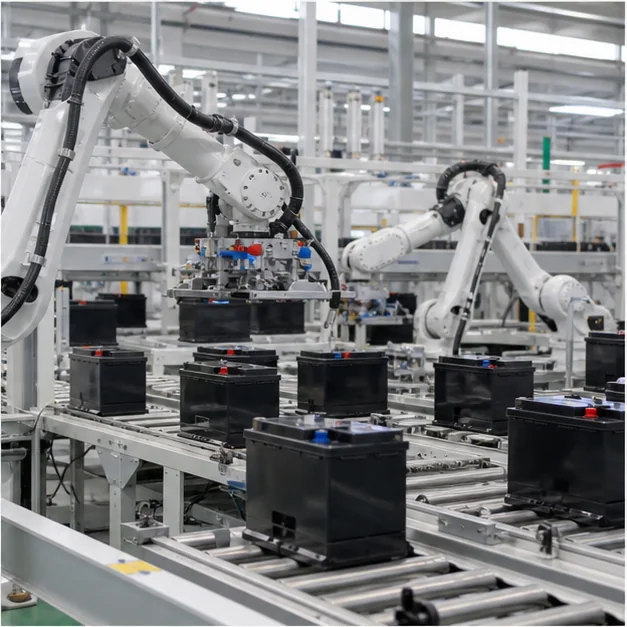
The DIN45–DIN100 and NS40–N200 ranges cover the most common passenger car, light commercial, and heavy-duty battery sizes in Europe and Asia. However, a cross-reference chart is only a starting point. Physical dimensions, terminal type, polarity, and cold cranking amps (CCA) must be verified against the vehicle's original equipment specification. For international buyers, the critical decision is not just which battery number matches, but which manufacturing process, quality control regime, and logistics partner can deliver consistent performance at scale. This guide provides a technical framework for evaluating suppliers, understanding production controls, and navigating the regulatory requirements for shipping lead-acid batteries from China.
Understanding DIN and JIS Battery Codes: What the Numbers Actually Mean
DIN (Deutsches Institut für Normung) and JIS (Japanese Industrial Standards) codes are the two dominant classification systems for automotive batteries in Europe and Asia. They are not interchangeable, and a cross-reference chart must account for the underlying physical and electrical parameters.
DIN Codes: European Standard for Performance and Fit
DIN codes, such as DIN45, DIN60, DIN75, DIN88, and DIN100, primarily indicate the battery's performance class, not its physical dimensions. The number roughly correlates with the battery's capacity in ampere-hours (Ah) under a 20-hour discharge rate, but modern DIN codes also incorporate CCA ratings and terminal layout. For example, a DIN75 battery typically has a capacity of 70–80 Ah and a CCA of 680–780 A, but the physical case may vary between manufacturers. The European standard EN 50342.1 defines the test methods for CCA, capacity, and charge acceptance, and it is this standard that importers should reference when comparing batteries from different factories.
JIS Codes: Japanese Standard for Physical Dimensions
JIS codes, such as NS40, N50, N70, N100, and N200, are more directly tied to physical dimensions. The "N" prefix indicates a standard automotive battery, while the number refers to a size class. The "S" suffix (e.g., NS40) indicates a smaller case with reduced height. JIS codes also specify terminal type (A, B, or C) and polarity (left or right). For instance, an NS40 battery measures approximately 236 mm (L) × 128 mm (W) × 200 mm (H) with a CCA of around 300 A, while an N200 battery is a heavy-duty unit measuring roughly 521 mm (L) × 278 mm (W) × 270 mm (H) with a CCA exceeding 1000 A.
Cross-Reference Limitations and Verification Steps
A cross-reference chart is a useful procurement tool, but it cannot replace physical verification. The same DIN code from two different factories may have different terminal positions or hold-down configurations. For fleet buyers and system integrators, the verification process should include:
- Measuring the original battery tray and hold-down clamp dimensions.
- Confirming terminal type (top post, side post, or DIN-style tapered post) and polarity orientation.
- Checking the vehicle's minimum CCA requirement for the local climate.
- Requesting the manufacturer's datasheet for the specific part number, not just the DIN or JIS code.
DIN45 to DIN100 / NS40 to N200: Comparative Specification Table
The table below provides typical specifications for common DIN and JIS battery sizes. These are representative examples, not universal values. Always confirm the exact specifications with the manufacturer before placing an order.
| Battery Code | Typical Capacity (Ah, 20h) | Typical CCA (A, EN) | Length (mm) | Width (mm) | Height (mm) | Terminal Type | Typical Application |
|---|---|---|---|---|---|---|---|
| DIN45 | 44–50 | 360–420 | 207–238 | 175 | 175–190 | DIN tapered | Small petrol cars (e.g., VW Polo, Ford Fiesta) |
| DIN60 | 60–63 | 540–600 | 242–278 | 175 | 175–190 | DIN tapered | Mid-size petrol/diesel cars (e.g., VW Golf, Audi A3) |
| DIN75 | 70–80 | 680–780 | 278–315 | 175 | 175–190 | DIN tapered | Large petrol/diesel cars, SUVs (e.g., BMW 3 Series, Mercedes C-Class) |
| DIN88 | 85–95 | 800–850 | 315–353 | 175 | 175–190 | DIN tapered | Luxury cars, performance vehicles (e.g., BMW 5 Series, Audi A6) |
| DIN100 | 95–110 | 850–950 | 353–393 | 175 | 175–190 | DIN tapered | Large SUVs, light commercial vehicles (e.g., Mercedes Sprinter, VW Crafter) |
| NS40 | 35–45 | 300–350 | 236 | 128 | 200 | JIS A or B | Small Japanese/Korean cars (e.g., Toyota Corolla, Hyundai Accent) |
| N50 | 45–55 | 350–450 | 260 | 173 | 225 | JIS A or B | Mid-size Japanese cars (e.g., Honda Civic, Nissan Sentra) |
| N70 | 60–75 | 500–600 | 305 | 173 | 225 | JIS A or B | Large Japanese cars, SUVs (e.g., Toyota Camry, Nissan X-Trail) |
| N100 | 90–110 | 700–800 | 410 | 176 | 233 | JIS A or B | Heavy-duty trucks, buses (e.g., Hino, Isuzu) |
| N200 | 180–220 | 1000–1200 | 521 | 278 | 270 | JIS A or B | Large commercial vehicles, marine, stationary power |
Note: CCA values are approximate and depend on the plate count, paste density, and acid concentration. Confirm the current EN or JIS standard with the manufacturer or an independent laboratory.
Sourcing from a Chinese OEM Factory: Production Processes and Quality Control
Buyers should audit the Chinese factory's manufacturing route from lead-alloy control and plate casting through curing, assembly, formation, capacity testing and final inspection. Plate casting parameters, grid alloy records and lot traceability should be included in the supplier quality plan. For export logistics, confirm the battery design and current carrier requirements before assigning UN2800 for qualifying non-spillable batteries or UN2794 for wet batteries; sea freight documentation, packaging and test evidence must match the actual product.
For international importers, the decision to source from a China automotive battery manufacturer is often driven by cost, capacity, and the ability to customize. However, the quality of Chinese lead-acid batteries varies significantly between factories. Understanding the manufacturing process is essential for making an informed sourcing decision.
Lead-Alloy and Plate Casting Controls
The performance and lifespan of a lead-acid battery are determined in the casting and curing stages. A reputable Chinese OEM factory will use a lead-calcium-tin alloy for the positive grid and a lead-calcium alloy for the negative grid to reduce water loss and improve charge acceptance. The casting process should be gravity casting or continuous casting, with strict control over the alloy composition. For example, the calcium content is typically 0.06–0.09% by weight, and the tin content is 1.2–1.8% for the positive grid. The factory should have an optical emission spectrometer (OES) to verify the alloy composition on every batch.
The grid thickness and pattern also affect performance. For DIN and JIS batteries, the grid thickness typically ranges from 1.1 mm to 1.6 mm, with a radial or expanded metal design. Thicker grids provide better corrosion resistance for deep-cycle applications, while thinner grids reduce weight and cost. The buyer should specify the intended application (starting, lighting, and ignition vs. auxiliary power) and request the grid design parameters.
Paste Mixing, Curing, and Formation
The active material is a paste of lead oxide, sulfuric acid, water, and additives. The paste density is typically 3.8–4.2 g/cm³ for the positive plate and 4.0–4.4 g/cm³ for the negative plate. After pasting, the plates are cured in a controlled environment at 40–60°C and 95–100% relative humidity for 24–48 hours. This process allows the lead oxide to recrystallize into a porous structure that maximizes surface area and capacity.
Formation is the electrochemical process that converts the cured paste into active material. This is a critical step that requires precise current and voltage control. A typical formation process for a DIN60 battery involves charging at a constant current of 5–10 A for 18–24 hours, followed by a discharge and recharge cycle. The factory should have a formation room with temperature control (25–30°C) and a data logging system to track each batch.
Production QC and Incoming Inspection
A reliable Chinese OEM factory will have a multi-stage QC process:
- Incoming material inspection: Lead ingots, alloying metals, separators, and containers are tested against the factory's incoming specification.
- In-process inspection: Grid weight, paste density, plate thickness, and assembly alignment are checked at regular intervals.
- Finished battery testing: Every battery is subjected to a capacity test (C20), a CCA test, and a charge acceptance test. A sample from each batch is also tested for vibration resistance, thermal shock, and water loss.
For B2B buyers, the key is to request the factory's QC documentation, including the test methods and acceptance criteria. If possible, arrange for a third-party inspection (e.g., SGS, Bureau Veritas) to witness the testing and verify the batch quality before shipment.
Export Logistics: UN2800 vs. UN2794 and Sea Freight Documentation
Shipping lead-acid batteries from China requires strict adherence to international dangerous goods regulations. The classification of the battery determines the packaging, labeling, and documentation requirements. It is critical to understand that not all lead-acid batteries are classified the same way.
UN2800: Batteries, Wet, Non-Spillable
UN2800 applies to sealed lead-acid batteries that have passed the vibration and pressure differential tests specified in the UN Manual of Tests and Criteria (Section 38.3). These batteries are classified as "non-spillable" and are exempt from some of the more stringent requirements of Class 8 hazardous materials, provided they meet the following conditions:
- The battery is capable of withstanding a vibration test and a pressure differential test without leakage.
- The battery is marked as "non-spillable" on the outer packaging.
- The battery is protected against short circuits.
UN2800 batteries can be shipped as limited quantities in some cases, but this depends on the carrier and the destination country. For sea freight, UN2800 batteries are still subject to the International Maritime Dangerous Goods (IMDG) Code, but the requirements are less onerous than for UN2794.
UN2794: Batteries, Wet, Filled with Acid
UN2794 applies to wet lead-acid batteries that are not classified as non-spillable. This includes conventional flooded batteries with vent caps that can leak if tipped over. These batteries are classified as Class 8 corrosive materials and require:
- A hazardous goods declaration (DGD) with the proper shipping name "Batteries, wet, filled with acid."
- Packaging that meets the UN performance standard (e.g., UN 4G fiberboard box or UN 1A2 steel drum).
- Labeling with the Class 8 corrosive label and the UN number.
- Segregation from incompatible materials (e.g., food, oxidizers) in the container.
Sea Freight Documentation and Verification
For both UN2800 and UN2794, the following documents are required for sea freight from China:
- Material Safety Data Sheet (MSDS): The manufacturer must provide an MSDS that is compliant with the Globally Harmonized System (GHS) and includes the UN number, transport hazard class, and emergency response information.
- Dangerous Goods Declaration (DGD): This document certifies that the goods are properly classified, packed, marked, and labeled.
- Certificate of Origin: Required for customs clearance in many countries.
- Packing List and Commercial Invoice: These must accurately describe the goods, including the UN number and the number of packages.
The buyer should verify the classification with the manufacturer and the carrier before shipment. A common error is assuming that all sealed batteries are UN2800. If the battery has a vent cap or has not been tested for non-spillability, it must be classified as UN2794. The carrier or a dangerous goods consultant can confirm the correct classification and documentation requirements.
Evaluating Chinese Suppliers: RFQ Data and Sourcing Decisions
When sourcing from a Chinese supplier, the request for quotation (RFQ) should include more than just the battery model and quantity. The following data points are essential for a meaningful comparison:
- Electrical specifications: Capacity (Ah), CCA (A), reserve capacity (RC), and internal resistance (mΩ).
- Physical specifications: Dimensions, weight, terminal type, and polarity.
- Material specifications: Alloy composition, grid thickness, separator type (PE, rubber, or glass mat), and container material (PP or ABS).
- Quality standards: The factory's ISO 9001 certification, the testing standards used (EN 50342, JIS D 5301, or SAE J537), and the warranty terms.
- Logistics: The Incoterms (e.g., FOB, CIF), the port of loading, and the expected lead time.
The buyer should also request a pre-shipment sample for independent testing. A reputable factory will provide a sample at cost, and the buyer should test it for CCA, capacity, and charge acceptance using a calibrated battery tester. The sample should be from the same production line and batch as the final order.
Tradeoffs in Supplier Selection
The lowest price per unit is rarely the lowest total cost of ownership. A battery with a lower CCA or a thinner grid may fail prematurely in a demanding application, leading to warranty claims and customer dissatisfaction. Conversely, a premium battery with a thicker grid and higher CCA may be over-specified for a small petrol car, resulting in unnecessary cost. The buyer should match the battery specification to the vehicle application and the local climate, and then compare suppliers on the basis of quality, delivery, and after-sales support.