For importers and fleet buyers sourcing from a China automotive battery manufacturer, verifying internal resistance (IR) and State of Health (SOH) is not optional—it is the difference between a reliable supply chain and a container of warranty claims. This guide explains the practical test methods, the limits of handheld testers, and how to align your incoming inspection with the realities of Chinese factory production and international shipping regulations.
Why Internal Resistance and SOH Matter for Imported Batteries
Internal resistance is the opposition to current flow within a battery, measured in milliohms (mΩ). It is the single most useful non-destructive indicator of a lead-acid battery's condition because it correlates with plate sulfation, grid corrosion, and electrolyte stratification—all failure modes that can occur during long sea freight or improper storage.
SOH is a broader concept: the percentage of remaining capacity or cranking ability relative to a new battery. You cannot measure SOH directly. You estimate it through conductance testing, impedance spectroscopy, or a full capacity discharge test. For a B2B buyer, the goal is to reject batteries that have degraded in transit or that left the factory with poor plate formation.
The Physics of Internal Resistance in Lead-Acid
A flooded automotive battery's IR is the sum of:
- Grid resistance (lead alloy composition)
- Plate surface resistance (active material porosity)
- Electrolyte resistance (specific gravity and temperature)
- Inter-cell connection resistance (welds and terminals)
Chinese OEM factories control these variables through alloy selection (calcium-tin for maintenance-free, antimony for deep-cycle) and plate curing processes. When you measure IR, you are indirectly auditing those factory controls.
Test Method 1: Conductance Testing (The Practical Standard)
Conductance testers (e.g., Midtronics, Argus, or Chinese equivalents) apply a small AC signal and measure the battery's response. They output a CCA or SOH percentage. This is the most common method for incoming inspection because it is fast, non-destructive, and does not require a full charge.
Procedure for imported battery verification:
- Let the battery rest at room temperature (20–25°C) for at least 4 hours after arrival.
- Clean terminals and ensure a solid connection.
- Enter the rated CCA and Ah from the sidewall label.
- Record the conductance value and the tester's SOH estimate.
- Compare against the manufacturer's minimum acceptance threshold (typically 70–80% SOH for new stock).
Caveat: Conductance testers are calibrated for flooded lead-acid. If your shipment includes AGM or gel batteries, use a tester with a specific AGM setting. A generic tester may misread a healthy AGM battery as weak.
Interpreting Conductance Results
| Battery Type | Rated CCA (Example) | New IR (mΩ) | Conductance SOH at 25°C | Action Threshold |
|---|---|---|---|---|
| Flooded 60 Ah | 540 CCA | 4.5–6.0 | 90–100% | Reject below 75% |
| Flooded 80 Ah | 680 CCA | 3.5–5.0 | 90–100% | Reject below 75% |
| AGM 70 Ah | 760 CCA | 2.5–4.0 | 85–95% | Reject below 70% |
| Gel 100 Ah | 850 CCA | 3.0–4.5 | 85–95% | Reject below 70% |
Values are illustrative ranges for common automotive sizes. Always confirm the specific acceptance criteria with your supplier and test equipment manufacturer.
Test Method 2: Impedance Spectroscopy (For Higher-Value Shipments)
Electrochemical Impedance Spectroscopy (EIS) measures complex impedance across a range of frequencies. It provides a more detailed picture of the battery's internal state—separating charge transfer resistance from diffusion limitations. This is overkill for routine container inspection but valuable for:
- Verifying a new supplier's production consistency
- Investigating a batch of failures
- Auditing the Chinese supplier quality claims before a large PO
EIS equipment is expensive and requires trained operators. Most importers use it only for arbitration or supplier qualification, not for 100% inspection.
Test Method 3: Full Capacity Discharge (The Definitive SOH Test)
The only way to know true SOH is to discharge the battery at a C/20 rate (e.g., 3A for a 60Ah battery) to 10.5V, measure the delivered Ah, and divide by the rated Ah. This takes 20 hours per battery, so it is impractical for full-container inspection.
Use this method for:
- Random sampling (1–2% of a shipment)
- Dispute resolution with the factory
- Pre-shipment inspection at the China battery manufacturer facility
A battery that delivers less than 80% of rated capacity after a full charge is considered failed, regardless of what a conductance tester says.
Sourcing from China: Factory QC, Manufacturing Controls, and Export Logistics
Buyers should audit the Chinese factory's manufacturing route from lead-alloy control and plate casting through curing, assembly, formation, capacity testing and final inspection. Plate casting parameters, grid alloy records and lot traceability should be included in the supplier quality plan. For export logistics, confirm the battery design and current carrier requirements before assigning UN2800 for qualifying non-spillable batteries or UN2794 for wet batteries; sea freight documentation, packaging and test evidence must match the actual product.
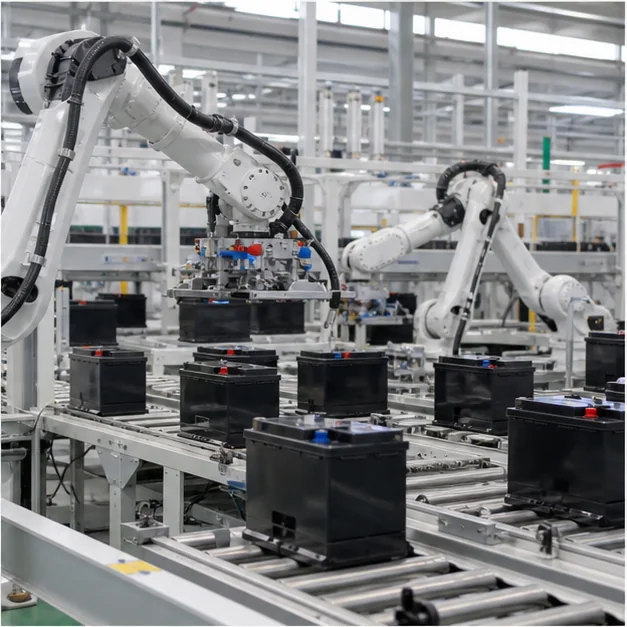
When you import car batteries from China, you are buying the output of a manufacturing process that varies significantly between factories. Understanding what happens on the production line helps you interpret your test results.
Plate Casting and Lead-Alloy Controls
Chinese OEM factories typically use one of two processes:
- Book mold casting for low-cost, high-volume plates
- Expanded metal for thinner, more consistent grids
The lead alloy is critical. A reputable factory will certify the calcium, tin, and antimony content. Ask for the alloy certificate with every RFQ. If a factory cannot provide one, treat that as a red flag. Grid thickness directly affects IR—thicker grids have lower resistance but heavier weight. A factory that cuts grid thickness to save lead will produce batteries with higher IR and shorter life.
Production QC and Formation
The formation process (first charge) determines the active material structure. Poor formation leads to high initial IR and rapid capacity loss. A serious Chinese factory will:
- Control formation temperature within ±2°C
- Use a multi-step charge profile
- Test 100% of batteries for voltage and IR before packaging
Ask your supplier for their in-process IR distribution data. A good factory will share this without hesitation. If they refuse, consider it a warning.
Export Logistics: UN2794 vs. UN2800
This is where many importers make costly mistakes. The UN classification determines your shipping options and documentation.
- UN2794 applies to wet, non-spillable lead-acid batteries. These are the standard flooded automotive batteries. They are not subject to the full dangerous goods regulations if they pass the vibration and pressure tests in Special Provision 238.
- UN2800 applies to spillable lead-acid batteries. These are typically vented or older designs that can leak electrolyte if inverted.
Critical distinction: The classification is based on the battery's design and test results, not on the manufacturer's location. A Chinese factory can produce both types. You must confirm which UN number applies to your specific SKU.
Sea freight documentation:
- For UN2794 batteries: You need a "Battery Test Report" from the factory, a Material Safety Data Sheet (MSDS), and a shipper's declaration for non-dangerous goods (if the carrier accepts the SP238 exemption).
- For UN2800 batteries: Full dangerous goods declaration, IMDG Code compliance, and potentially a certified container.
Verification step: Before booking freight, send your supplier's test report to your freight forwarder and ask them to confirm the classification with the carrier. Do not assume—the rules are updated periodically, and a misclassification can delay your shipment at port or result in fines.
RFQ Data and Sourcing Decisions
When requesting quotes from Chinese factories, include these technical requirements:
- Rated CCA and Ah at -18°C
- Maximum internal resistance at 25°C (e.g., ≤ 5.5 mΩ for a 60Ah)
- Minimum SOH after 30 days of storage (e.g., ≥ 90%)
- UN classification (UN2794 or UN2800) with test report
- Sampling plan (e.g., AQL 1.0 for IR, 0.65 for leakage)
A factory that cannot commit to these numbers in writing is not ready for export. The best Chinese suppliers will provide a pre-shipment test report from a third-party lab (e.g., SGS, TÜV, or Bureau Veritas) at your cost.
Incoming Inspection Protocol for Importers
Establish a repeatable process for every container:
- Visual inspection: Check for terminal corrosion, case deformation, and electrolyte leakage. Reject any battery with visible damage.
- Open-circuit voltage (OCV): A fully charged battery should read 12.6–12.8V. Below 12.4V indicates self-discharge during transit.
- Conductance test: Measure IR and SOH on a 10% sample. If more than 2% of the sample fails, expand to 100% inspection.
- Capacity test: For every 100 batteries, select one for a full discharge test. This is your arbitration tool.
- Documentation check: Verify the UN number on the packing list matches the battery type. Keep the factory's test report on file.