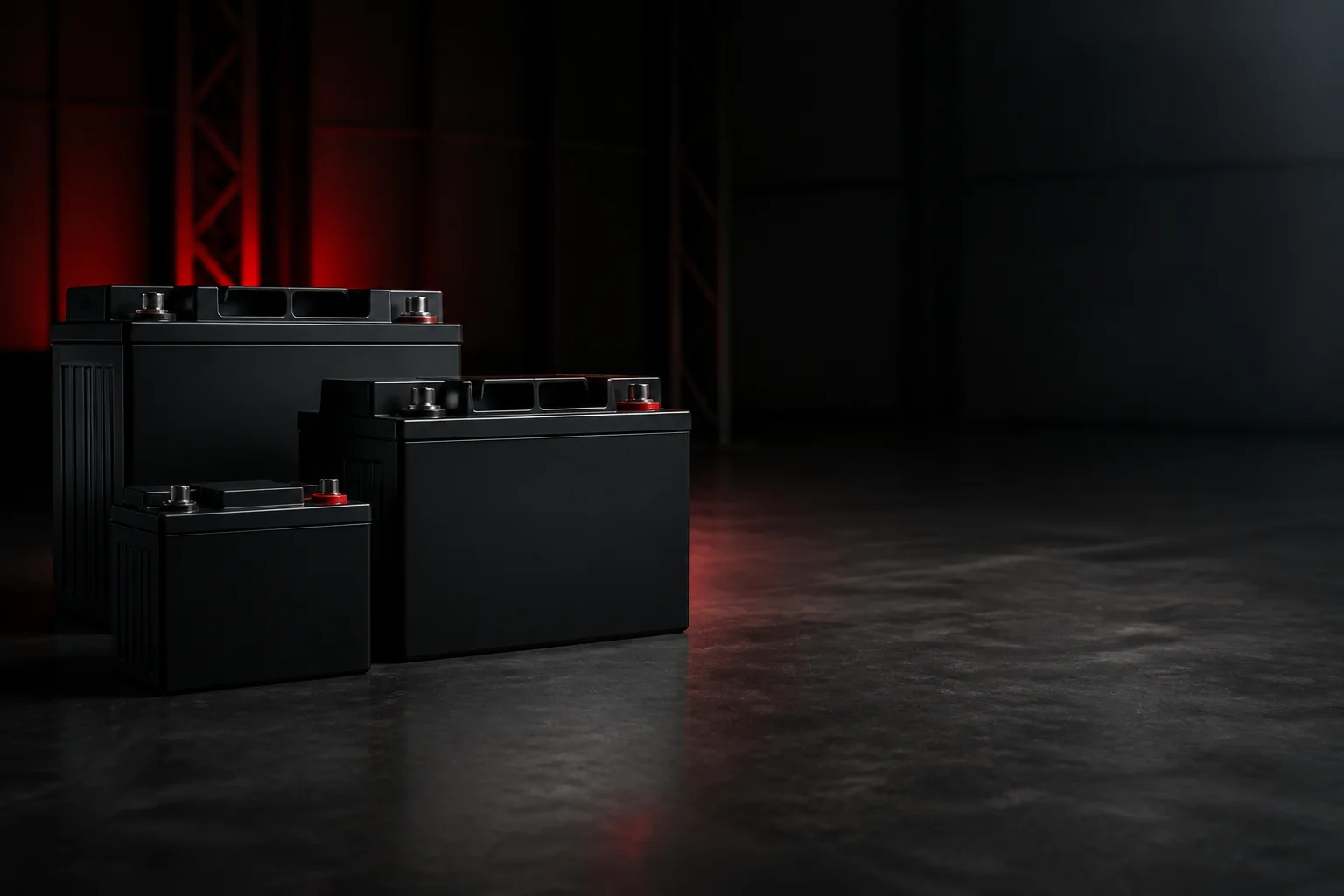
Factory-activated GEL motorcycle batteries eliminate the need for acid filling and initial charging at the destination, reducing warehouse labor and safety compliance burdens for overseas retailers. Sourcing these units from a China battery manufacturer requires careful evaluation of plate casting processes, electrolyte immobilization methods, and the correct UN classification for sea freight. This guide provides procurement engineers and distributors with the technical criteria to assess supplier capabilities, verify logistics documentation, and structure RFQs that yield comparable data across Chinese factories.
Understanding Factory-Activated GEL Technology for Motorcycle Applications
Factory-activated (also called "wet-charged" or "filled and charged") GEL batteries ship with electrolyte already absorbed in a silica-thickened matrix. Unlike AGM (Absorbent Glass Mat) batteries, GEL cells use a thixotropic gel that does not stratify under vibration, making them suitable for high-vibration motorcycle environments. The activation process occurs at the factory under controlled vacuum filling, which ensures consistent electrolyte distribution and minimizes gas channeling.
GEL vs. AGM vs. Flooded: Procurement Considerations
| Parameter | Factory-Activated GEL | AGM (Factory-Sealed) | Flooded (Dry-Charged) |
|---|---|---|---|
| Electrolyte state | Thixotropic silica gel | Absorbed in glass mat | Liquid sulfuric acid |
| Shipping classification | UN2800 (if non-spillable) or UN2794 | UN2800 (typically) | UN2794 (spillable) |
| Shelf life (filled) | 12–18 months at 20°C | 18–24 months at 20°C | Indefinite (dry) |
| Vibration resistance | Excellent (gel immobilizes electrolyte) | Good (mat holds acid) | Poor (free liquid) |
| Cycle life (example, 50% DoD) | 400–600 cycles | 300–500 cycles | 200–300 cycles |
| Cold cranking amps (CCA, typical) | 80–120% of equivalent flooded | 100–130% of equivalent flooded | Baseline |
| Maintenance | None | None | Requires water top-up |
Values are indicative ranges from industry literature; verify specific supplier datasheets.
For overseas retailers, the primary advantage of factory-activated GEL is the elimination of acid handling at the warehouse. This reduces liability under local occupational safety regulations and removes the need for specialized PPE and spill containment infrastructure. However, the tradeoff is a finite shelf life—once filled, the battery begins self-discharging at approximately 2–3% per month at 20°C, accelerating at higher temperatures.
Sourcing from China: Manufacturing Processes and Quality Control
Buyers should audit the Chinese factory's manufacturing route from lead-alloy control and plate casting through curing, assembly, formation, capacity testing and final inspection. Plate casting parameters, grid alloy records and lot traceability should be included in the supplier quality plan. For export logistics, confirm the battery design and current carrier requirements before assigning UN2800 for qualifying non-spillable batteries or UN2794 for wet batteries; sea freight documentation, packaging and test evidence must match the actual product.
When evaluating a China motorcycle battery supplier, the critical differentiator is not the assembly line but the metallurgical and electrochemical controls upstream. Chinese factories vary significantly in their ability to produce consistent lead-calcium-tin grids with tight dimensional tolerances.
Plate Casting and Alloy Control
The grid alloy determines corrosion resistance, gassing rates, and mechanical strength. For GEL motorcycle batteries, lead-calcium-tin (Pb-Ca-Sn) is standard for maintenance-free operation. A reputable Chinese factory will:
- Use continuous grid casting (vs. book mold) for thickness uniformity within ±0.05 mm
- Verify alloy composition via optical emission spectroscopy (OES) on every melt batch
- Control tin content between 1.2–1.8% to prevent passivation at the positive grid/active material interface
- Monitor antimony levels below 0.001% for calcium alloys (antimony increases gassing)
Request the supplier's alloy certificate of analysis (CoA) for each production lot. A factory that cannot provide OES data for grid alloy composition should be disqualified for high-volume procurement.
Plate Curing and Formation
After pasting, plates undergo a curing process that converts lead oxide paste into basic lead sulfates. The curing chamber's temperature (typically 50–70°C) and relative humidity (95–100%) must be controlled for 24–72 hours. Inadequate curing leads to plate cracking and premature capacity loss.
Formation (the first charge) is where GEL batteries differ from flooded types. For factory-activated units, formation occurs before electrolyte addition or with a diluted electrolyte that is later replaced. The formation protocol should follow a multi-step current profile (e.g., 0.1C for 16–20 hours, then finishing charge). Ask the supplier for formation logs—these should show voltage and current curves, not just a completion timestamp.
Production QC and Testing
A credible Chinese factory will conduct the following tests on a sampling basis (typically AQL 1.0/2.5):
- Capacity test (C20 discharge) at 25°C ± 2°C
- CCA test at -18°C per EN 60095 or JIS D5302
- Charge retention (28 days at 40°C, then capacity check)
- Vibration test per ISO 12405 (for motorcycle applications)
- Leak test via helium mass spectrometry on the valve and case seals
For GEL batteries specifically, verify that the factory measures gel viscosity and silica content (typically 4–8% fumed silica by weight). Inconsistent gel viscosity leads to electrolyte stratification and premature dry-out.
UN2800 vs. UN2794: Correct Classification for Sea Freight
A common error in battery procurement is assuming all lead-acid batteries ship as UN2800. The distinction is critical for customs clearance and carrier acceptance.
UN2800: Batteries, Wet, Non-Spillable
This classification applies when the battery passes the vibration and pressure differential tests in the UN Manual of Tests and Criteria (Section 38.3, Subsection 38.3.3). For lead-acid batteries, the test requires:
- No free liquid in the battery when shaken
- No leakage after 24 hours at 55°C with a pressure differential of 88 kPa
Factory-activated GEL batteries typically qualify as UN2800 because the gel immobilizes the electrolyte. However, this must be verified by the supplier's test report from an accredited laboratory. The battery must also be marked "NON-SPILLABLE" and pass the 1.2-meter drop test.
UN2794: Batteries, Wet, Filled with Acid (Spillable)
If the battery fails the non-spillable tests—or if the supplier cannot provide documentation—it must ship as UN2794. This classification imposes stricter requirements:
- Outer packaging must be leak-proof and withstand a 1.2-meter drop test
- Batteries must be oriented upright (unless the packaging is approved for other orientations)
- Additional hazard communication labels (Corrosive, Class 8) are required
For sea freight, UN2794 shipments may require segregation from other corrosive materials and specific stowage positions on the vessel. This increases freight costs and transit complexity.
Verification Steps for Importers
- Request the UN38.3 test summary (even though it is primarily for lithium, many carriers require it for all battery types)
- Ask for the manufacturer's declaration of non-spillability with reference to the specific test standard
- Confirm with your freight forwarder whether the carrier accepts UN2800 for the intended route (some Asian and Middle Eastern carriers have stricter interpretations)
- Check the IMDG Code amendment in effect—the classification criteria have been stable, but packaging requirements may change
Note: The UN classification is not a static property. It depends on the specific battery design and test results. Always request the current test report from the supplier and confirm with your carrier before booking.
Export Logistics and Documentation from Chinese Factories
Sourcing from China involves navigating export procedures that differ from domestic procurement. A factory-activated GEL battery shipment requires specific documentation to clear Chinese customs and enter the destination country.
Required Export Documents
- Commercial Invoice with HS code (typically 8507.10 for lead-acid motorcycle batteries)
- Packing List indicating battery quantity, weight, and UN number
- Bill of Lading (sea freight) or Air Waybill (air freight)
- Certificate of Origin (Form E for ASEAN destinations, or general CO)
- MSDS (Material Safety Data Sheet) in the destination language
- UN Test Report (for UN2800 classification)
- Export License (only required for certain restricted destinations)
Sea Freight Considerations
For sea freight, the IMDG Code governs the transport of dangerous goods. UN2800 batteries are classified as Class 9 (miscellaneous dangerous goods) and require:
- Limited Quantity (LQ) exemption if the battery meets specific criteria (typically ≤ 30 kg gross weight per package)
- Dangerous Goods Declaration signed by a trained person
- Container packing certificate (for FCL shipments)
A Chinese factory with export experience will have a designated DG safety adviser who can prepare these documents. Verify that the factory's DG declaration matches the actual battery weight and packaging configuration.
Incoterms and Risk Transfer
For overseas retailers, FOB (Free on Board) or CIF (Cost, Insurance, and Freight) are common. However, the risk transfer point matters for battery damage claims:
- FOB (e.g., FOB Shanghai): Risk transfers when the battery is loaded onto the vessel. The importer bears sea freight risk.
- CIF (e.g., CIF Hamburg): The supplier arranges and pays for freight and insurance, but risk still transfers at the port of loading.
For battery shipments, consider DAP (Delivered at Place) to shift transit risk to the supplier. This is particularly relevant for GEL batteries, which are sensitive to temperature extremes during transit.
RFQ Data and Supplier Evaluation Criteria
To obtain comparable quotes from Chinese factories, structure your RFQ with specific technical parameters. Vague requests like "12V 9Ah GEL battery" will yield inconsistent offers.
Essential RFQ Fields
| Parameter | Unit | Required Data |
|---|---|---|
| Nominal voltage | V | 6 or 12 |
| Capacity (C20) | Ah | e.g., 9, 12, 18 |
| CCA at -18°C | A | Per EN/JIS standard |
| Dimensions (L×W×H) | mm | Include terminal height |
| Terminal type | — | Standard, bolt-on, or threaded |
| Weight (filled) | kg | ±5% tolerance |
| Shelf life at 20°C | months | Minimum acceptable |
| Operating temperature | °C | -20 to +50 |
| Cycle life (50% DoD) | cycles | Minimum 300 |
| UN classification | — | UN2800 or UN2794 |
| Certifications | — | CE, UL (if required) |
Verification Steps Before PO
- Request a pre-production sample (minimum 5 units) and test at your facility
- Audit the factory (in-person or via video) to verify formation and filling lines
- Check the UN test report date—it should be within 3 years
- Review the MSDS for silica content and electrolyte density (1.28–1.30 g/cm³ for GEL)
- Confirm the warranty terms in writing—do not rely on verbal assurances
Red Flags in Supplier Responses
- Inability to provide OES data for grid alloy
- No UN test report or refusal to share it
- Vague answers about gel composition (silica percentage)
- Quoting prices below raw material cost (lead is a commodity; check LME prices)
- Offering "universal" batteries that fit all motorcycle models without application-specific data