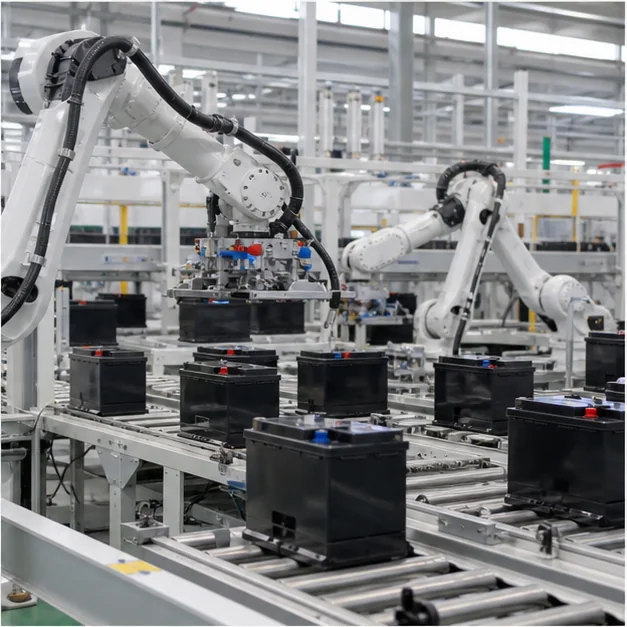
Heavy-duty commercial truck batteries operate under a unique combination of mechanical stress and electrical demand. Unlike passenger car starting batteries, these units must endure continuous chassis vibration, high under-hood temperatures, and repeated deep discharges from auxiliary loads such as liftgates, inverters, and sleeper cab electronics. When sourcing from a China battery manufacturer, the procurement decision cannot rest on CCA numbers alone. You must evaluate plate architecture, container anchoring, alloy composition, and the factory's ability to produce consistent cast grids under high-volume conditions. This guide provides a technical framework for importers, distributors, and fleet buyers to specify, verify, and import heavy-duty batteries that survive real-world commercial service.
Understanding the Mechanical and Electrical Demands of Commercial Truck Service
Vibration Profiles: More Than Just "Rough Roads"
Commercial truck batteries are mounted on steel trays directly to the frame rail or engine cradle. The vibration spectrum is not sinusoidal; it is random, broadband, and includes high-amplitude shocks from potholes, curb strikes, and loading dock impacts. A standard passenger car battery tested to ISO 12405 or similar may pass a simple 3-axis sine sweep, but that does not predict survival in a Class 8 truck.
The relevant test standards for heavy-duty batteries include IEC 60068-2-64 (random vibration) and SAE J2801 (heavy-duty battery vibration). These tests apply random PSD (power spectral density) profiles over 8–24 hours per axis, often with temperature cycling. When you request a vibration test report from a China automotive battery manufacturer, ask specifically whether the test was performed on the final assembled battery with electrolyte, or on a dry, unformed unit. The latter is significantly less meaningful.
Key mechanical failure modes to specify against:
- Grid cracking at the plate lug-to-strap weld joint.
- Active material shedding from the positive plate due to flexing.
- Container wall fatigue at the mounting flange or hold-down lug.
- Terminal post loosening from the lid-to-post seal.
Load Profiles: CCA Is Not the Whole Story
A commercial truck starter motor may draw 1,500–2,500 A for 5–10 seconds in cold conditions. However, the more demanding load is the auxiliary electrical system. A sleeper cab with a refrigerator, heater blower, and electronics can draw 15–30 A continuously for 8–10 hours overnight. This is a deep cycle, not a starting event. The battery must deliver this without excessive voltage drop, then recover during the next day's driving.
For this reason, heavy-duty batteries are often rated in reserve capacity (RC) and amp-hour (Ah) capacity at the 20-hour rate, not just CCA. A typical specification for a Group 31 chassis battery might be 1,150 CCA, 220 minutes RC, and 100 Ah. However, the plate design that achieves high CCA (thin plates, high surface area) is often poor at deep cycling. The tradeoff is real.
| Battery Type | Positive Plate Thickness (mm) | Typical CCA (Group 31) | Typical RC (min) | Cycle Life (80% DoD) | Best Application |
|---|---|---|---|---|---|
| Standard SLI (passenger) | 1.2 – 1.8 | 800 – 950 | 120 – 160 | 50 – 100 cycles | Light duty, frequent starts |
| Commercial HD (mixed duty) | 2.0 – 3.0 | 1,000 – 1,200 | 180 – 220 | 150 – 250 cycles | Regional truck, moderate aux load |
| Deep-cycle HD (heavy aux) | 3.5 – 4.5 | 900 – 1,100 | 220 – 300 | 300 – 500 cycles | Sleeper cab, liftgate, APU |
Note: Values are typical examples from industry datasheets, not universal guarantees. Confirm exact specifications with your supplier for each SKU.
Plate Alloy and Casting: The Core of Battery Durability
Lead-Calcium vs. Lead-Antimony: A Practical Tradeoff
Most modern commercial truck batteries use lead-calcium alloys for both positive and negative grids. Calcium reduces water consumption, which is critical for maintenance-free operation. However, calcium grids are more susceptible to corrosion at the grain boundaries when exposed to high under-hood temperatures (above 60°C). This leads to premature positive grid growth and eventual shorting.
Lead-antimony alloys (typically 1.5–3% antimony) are more forgiving under deep discharge and high temperature. They resist grid corrosion better and maintain adhesion of the active material. The downside is increased gassing, which means the battery requires periodic water addition. For a fleet that does not want to open the battery, this is a problem. For a mining truck or agricultural vehicle with daily maintenance, antimony may be the better choice.
When sourcing from a Chinese factory, ask for the exact alloy composition in the RFQ. A reputable Chinese supplier will provide a mill certificate for the lead alloy ingots, not just a verbal "calcium" or "antimony" label. Verify the calcium content is in the 0.06–0.09% range for positive grids; higher calcium reduces corrosion resistance.
Casting Methods: Book Mold vs. Continuous Casting
The two dominant grid manufacturing processes are:
- Book mold casting: Molten lead alloy is poured into a two-part mold. This is slower, but allows for thicker grids (up to 4.5 mm) and more complex grid designs. It is the preferred method for deep-cycle heavy-duty plates.
- Continuous casting (or expanded metal): A thin lead strip is slit and expanded into a diamond pattern. This is fast and cheap, but the resulting grid is thin (1.0–1.5 mm) and has sharp corners that can concentrate stress. It is suitable for SLI batteries, not for high-vibration, deep-cycle service.
For heavy-duty commercial truck batteries, insist on book mold cast positive grids. The factory should be able to show you the mold drawings and the casting temperature control logs. A well-run Chinese factory will maintain mold temperature at 150–180°C and lead pot temperature at 450–480°C. Inconsistent temperature leads to cold shuts, porosity, and weak grid nodes.
Sourcing from a Chinese OEM Factory: Manufacturing Controls and Export Logistics
Buyers should audit the Chinese factory's manufacturing route from lead-alloy control and plate casting through curing, assembly, formation, capacity testing and final inspection. Plate casting parameters, grid alloy records and lot traceability should be included in the supplier quality plan. For export logistics, confirm the battery design and current carrier requirements before assigning UN2800 for qualifying non-spillable batteries or UN2794 for wet batteries; sea freight documentation, packaging and test evidence must match the actual product.
Factory Process Verification: What to Audit
When you visit or audit a China automotive battery manufacturer, focus on the following process controls:
- Lead oxide mill: The Barton pot or ball mill must produce oxide with a specific surface area of 2.0–2.6 m²/g and an oxidation percentage of 70–80%. Too high oxidation makes paste stiff and hard to cure; too low leads to poor adhesion.
- Paste mixing: The paste density should be 3.8–4.2 g/cm³ for positive plates. The mixing temperature must not exceed 60°C to prevent premature curing. Ask for the batch records.
- Curing and drying: Plates must be cured at 60–75°C with high humidity (95% RH) for 24–48 hours, then dried. This converts free lead into basic lead sulfates, which bind the active material to the grid. A factory that skips or shortens this step will have plates that shed active material under vibration.
- Formation: The electrochemical formation process must be controlled for current density and total Ah input. Under-formation leaves unreacted lead sulfate, which reduces capacity and causes premature failure.
Export Logistics: UN2800 vs. UN2794 and Sea Freight Documentation
This is a critical area where many importers make costly errors. The UN number for your battery shipment depends on the battery's construction and electrolyte state:
- UN2800 applies to sealed lead-acid batteries (valve-regulated, non-spillable). These are typically AGM or gel batteries. They are not subject to the full dangerous goods regulations if they pass the vibration and pressure differential tests in Special Provision 238 of the UN Model Regulations. However, you must still declare them as UN2800 on the shipping document.
- UN2794 applies to wet, non-spillable lead-acid batteries (flooded, with liquid electrolyte). These are fully regulated as Class 8 corrosive substances. They require a dangerous goods declaration, proper packaging (UN-approved boxes or pallets with drip trays), and labeling.
Do not assume all batteries from a Chinese factory are UN2800. A flooded heavy-duty battery with removable vent caps is almost certainly UN2794. A sealed AGM battery with a one-way pressure relief valve may be UN2800, but only if the factory has the test report proving it passes the vibration and pressure tests.
For sea freight, the following documents are typically required:
- Material Safety Data Sheet (MSDS) for the battery electrolyte.
- Dangerous Goods Declaration (DGD) if shipping as UN2794.
- Certificate of Origin (for tariff purposes, not for safety).
- Battery test reports (UN38.3 is for lithium; for lead-acid, the relevant tests are the vibration and pressure differential tests for UN2800).
When requesting a quote from a Chinese supplier, ask them to state the exact UN number for each SKU and provide the supporting test report. If they cannot, treat the shipment as UN2794 and plan for full DG logistics. The cost difference is significant: UN2800 can ship as general cargo in many cases, while UN2794 requires DG container booking and potentially higher freight rates.
RFQ Data: What to Send to a Chinese Supplier
To get accurate pricing and lead times, your RFQ should include:
- Battery group size (e.g., Group 31, 4D, 8D) and terminal type (SAE post, stud, or dual).
- Voltage and capacity (Ah at 20-hr rate) and CCA at -18°C.
- Vibration test requirement (IEC 60068-2-64 or SAE J2801) and whether you need a third-party witness test.
- Operating temperature range (e.g., -30°C to +50°C).
- Mounting configuration (top hold-down, side bracket, or L-bracket).
- Target cycle life at 50% depth of discharge.
- Whether the battery must be maintenance-free (calcium) or serviceable (antimony).
- Packaging requirement: individual boxes, palletized, or export cartons with UN-approved markings.
A professional Chinese factory will respond with a technical datasheet, a drawing, and a clear statement of the UN number. If they only send a price list, that is a red flag.
Verification and Quality Assurance Before Shipment
Third-Party Inspection: What to Check
Before you authorize shipment, consider a third-party inspection (e.g., SGS, Bureau Veritas, or TÜV) at the factory. The inspection should cover:
- Dimensional check: Compare the battery's length, width, and height against the drawing. Tolerance should be ±2 mm.
- Open circuit voltage (OCV): A fully charged battery should read 12.60–12.80 V (for a 12V unit) after 24 hours of rest.
- Capacity test: Discharge at the 20-hour rate to 10.5 V. The measured capacity should be at least 95% of the rated Ah.
- Vibration test: If you specified SAE J2801, the inspector should witness the test on a random vibration table. The battery must not leak, crack, or lose more than 5% of its capacity after the test.
- Torque test on terminals: The terminal nuts should withstand the specified torque (typically 8–12 Nm) without stripping.
Documentation Review
Ask for the following documents before payment:
- Batch test certificate for the specific production lot.
- Lead alloy composition report from the ingot supplier.
- Formation charge records showing the Ah input per cell.
- UN test report (if claiming UN2800).
Do not accept a generic "ISO 9001" certificate as proof of battery quality. ISO 9001 is a process standard, not a product standard. The relevant product standards are IEC 60095 (for SLI) and IEC 61427 (for cyclic applications), but these are not always mandatory for export. Confirm with your buyer or local authority which standards apply in your destination market.