The Short Answer
For a 5kVA inverter at 48V, a minimum battery bank of 200Ah (C10) is required for 2 hours of autonomy at 80% depth of discharge (DoD). For a 10kVA inverter at 48V, you need 400Ah (C10) for the same runtime. The formula is: Capacity (Ah) = (Inverter Power (W) × Autonomy Hours) ÷ (System Voltage × DoD × Inverter Efficiency). Always use the C10 discharge rate for solar applications, not the C20 rate commonly printed on consumer batteries. When sourcing from a China solar gel battery manufacturer, verify the C10 rating, plate thickness, and export documentation (UN2800 for sealed, UN2794 for vented) before committing to a purchase order.
Why Battery Bank Sizing Fails: The kVA vs. kWh Trap
Most importers and EPC contractors make the same mistake: they multiply the inverter's kVA rating by the desired backup hours and divide by the battery voltage. This yields a theoretical capacity that is 30–50% higher than what the battery can actually deliver.
The problem is threefold:
- Power Factor (PF) — A 5kVA inverter does not draw 5,000W. At a typical PF of 0.8, the real load is 4,000W. Sizing for 5,000W overestimates the bank by 25%.
- Inverter Efficiency — Modern inverters operate at 90–94% efficiency. The battery must supply more energy than the inverter outputs to cover conversion losses.
- Depth of Discharge (DoD) — Lead-acid batteries, including AGM and gel, suffer accelerated plate corrosion and capacity loss if regularly discharged beyond 50–80% DoD. A 200Ah battery at 50% DoD only provides 100Ah of usable capacity.
The correct formula is:
Battery Capacity (Ah) = (Inverter kVA × 1000 × PF × Autonomy Hours) ÷ (System Voltage × DoD × Inverter Efficiency)
Example for a 5kVA inverter, 48V system, 2 hours autonomy, 0.8 PF, 0.92 efficiency, 80% DoD:
(5 × 1000 × 0.8 × 2) ÷ (48 × 0.8 × 0.92) = 8,000 ÷ 35.33 = 226.4 Ah
Round up to the nearest standard size: 250Ah (C10). For a 10kVA inverter, double the result: 500Ah (C10).
Step-by-Step Sizing Method for 5kVA and 10kVA Systems
Step 1: Define the Load Profile
Do not size for the inverter's maximum rating. Instead, determine the continuous load — the sum of all appliances that will run simultaneously during a power outage. For a 5kVA system, a realistic continuous load is 2.5–3.5kW. For a 10kVA system, it is 5–7kW.
Step 2: Select Autonomy Hours
Autonomy is the number of hours the system must run without grid or solar input. Common values:
| Application | Autonomy (Hours) |
|---|---|
| Residential backup | 2–4 |
| Commercial/Telecom | 4–8 |
| Off-grid solar | 12–24 (with solar recharge) |
Step 3: Choose the Discharge Rate (C10 vs. C20)
This is the most critical technical decision. Lead-acid batteries are rated at a specific discharge duration:
- C20: Capacity when discharged over 20 hours. This is the marketing number.
- C10: Capacity when discharged over 10 hours. This is the engineering number for solar/inverter loads.
A 200Ah (C20) battery is typically only 170–180Ah (C10). If you size using C20 and discharge in 2–4 hours, you will get far less usable energy than calculated. Always request the C10 rating from your supplier.
Step 4: Apply Temperature Derating
Battery capacity drops in cold environments. At 10°C, a lead-acid battery delivers only 85–90% of its rated capacity. If your installation site experiences temperatures below 15°C, multiply the calculated capacity by 1.1–1.2.
Step 5: Round Up to Standard Sizes
Battery banks are built from series/parallel strings of 12V or 2V cells. For a 48V system:
- 4 × 12V batteries in series (common for 5kVA)
- 24 × 2V cells in series (common for 10kVA and above)
Standard capacities for 12V gel batteries: 100Ah, 150Ah, 200Ah, 250Ah. For 2V cells: 200Ah to 3000Ah.
Specification Table: Recommended Banks for 5kVA and 10kVA
The table below shows minimum recommended configurations for typical loads. Confirm the C10 rating with your supplier before ordering.
| Inverter Rating | System Voltage | Continuous Load (W) | Autonomy (Hours) | DoD | Required C10 Capacity (Ah) | Recommended Configuration |
|---|---|---|---|---|---|---|
| 5kVA | 48V | 3,000W | 2 | 80% | 170Ah | 4 × 12V 200Ah (C10) in series |
| 5kVA | 48V | 3,000W | 4 | 50% | 272Ah | 4 × 12V 300Ah (C10) in series |
| 10kVA | 48V | 6,000W | 2 | 80% | 340Ah | 4 × 12V 400Ah (C10) in series |
| 10kVA | 48V | 6,000W | 4 | 50% | 544Ah | 24 × 2V 600Ah (C10) in series |
| 10kVA | 96V | 6,000W | 2 | 80% | 170Ah | 8 × 12V 200Ah (C10) in series |
Note: The above assumes 0.8 PF and 0.92 inverter efficiency. For 96V systems, the current is halved, reducing cable and battery costs.
Sourcing from a Chinese OEM Factory: Manufacturing, QC, and Export Logistics
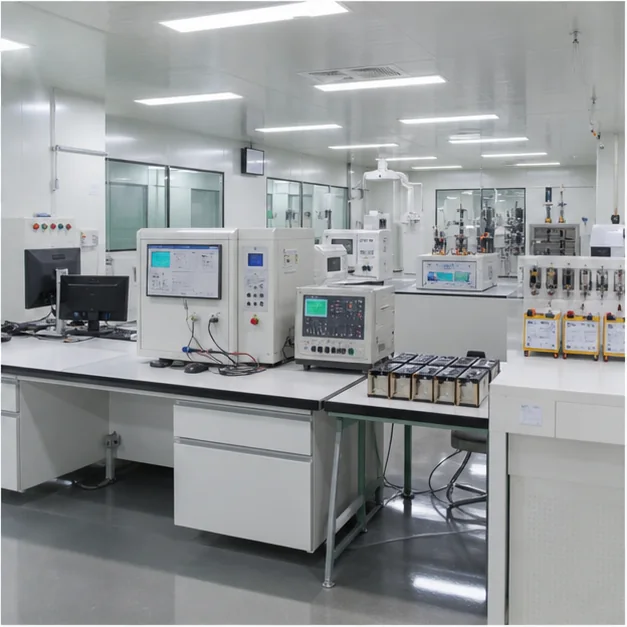
Buyers should audit the Chinese factory's manufacturing route from lead-alloy control and plate casting through curing, assembly, formation, capacity testing and final inspection. Plate casting parameters, grid alloy records and lot traceability should be included in the supplier quality plan. For export logistics, confirm the battery design and current carrier requirements before assigning UN2800 for qualifying non-spillable batteries or UN2794 for wet batteries; sea freight documentation, packaging and test evidence must match the actual product.
When you source battery banks from China, you are not just buying a commodity — you are buying into a manufacturing process that determines cycle life, consistency, and safety. Here is what a competent China solar gel battery manufacturer does differently, and how to verify it.
Plate Casting and Lead-Alloy Controls
The positive plate is the heart of a lead-acid battery. Chinese OEM factories use either lead-calcium-tin or lead-antimony alloys. For solar/gel batteries, lead-calcium-tin with a low calcium content (0.06–0.09%) is preferred because it reduces gassing and water loss. The casting process must control:
- Grid thickness: For deep-cycle solar batteries, positive grids should be 2.0–2.5mm thick. Thinner grids (1.5mm) are for automotive starting batteries and will fail quickly under deep discharge.
- Casting temperature: Lead is cast at 450–500°C. Inconsistent temperature causes micro-cracks that lead to grid corrosion.
- Paste density: The active material (lead dioxide) is pasted onto the grid. Density should be 4.0–4.2 g/cm³. Lower density means less capacity; higher density means poor adhesion.
Verification step: Request the factory's grid thickness specification and paste density range in writing. A reputable Chinese OEM will provide this without hesitation.
Production QC and Formation Process
After assembly, batteries undergo formation — the first charge that converts the paste into active material. This process takes 48–72 hours. Poor factories rush formation to save time, resulting in batteries with inconsistent capacity.
Key QC checkpoints in a Chinese factory:
- 100% capacity test on a sample batch (typically 1–3% of production)
- Open-circuit voltage (OCV) check after 72 hours of rest — should be 12.80–13.00V for a 12V battery
- Internal resistance measurement — should be below 5mΩ for a 200Ah battery
- Leak test for sealed (VRLA) batteries — no acid mist or electrolyte escape
Sourcing decision: Ask for the factory's QC checklist and the defect rate for the last three production batches. A defect rate above 2% is a red flag.
Export Logistics: UN2800 vs. UN2794
This is where many importers make costly errors. The UN number determines how your batteries are shipped and what documentation is required.
- UN2800 applies to sealed lead-acid batteries (valve-regulated, non-spillable). This includes most gel and AGM batteries. They are classified as Class 8 corrosive substances but are exempt from many dangerous goods regulations if they pass the vibration and pressure differential tests in the UN Manual of Tests and Criteria.
- UN2794 applies to wet, non-spillable lead-acid batteries (vented/flooded). These are fully regulated as Class 8 dangerous goods and require more stringent packaging, labeling, and shipping documentation.
Important: You cannot choose either number arbitrarily. The UN number is determined by the battery's construction. A sealed gel battery is UN2800; a flooded battery is UN2794. If your supplier tells you "we ship all batteries as UN2800," and you are buying flooded batteries, your shipment will be rejected at the port.
Sea freight documentation for both types typically includes:
- MSDS (Material Safety Data Sheet) — must be specific to the battery chemistry and manufacturer
- Dangerous Goods Declaration — required for UN2794, sometimes waived for UN2800 if the battery passes the vibration test
- Certificate of Origin — for tariff purposes
- Packing List and Commercial Invoice — must state the UN number and battery weight
Verification step: Ask the factory for a copy of their UN test report (for UN2800) or their dangerous goods certificate (for UN2794). Confirm with your freight forwarder that the documentation matches the battery type you are importing. Do not rely on the factory's word alone — the carrier is the final authority on what is acceptable.
Common Sizing Errors and How to Avoid Them
Error 1: Using C20 Ratings for Solar Loads
As discussed, C20 ratings overstate capacity by 10–15% for the 2–4 hour discharge typical of inverter systems. Always specify C10 in your RFQ.
Error 2: Ignoring the Peukert Effect
The Peukert effect states that as discharge current increases, available capacity decreases. A battery rated 200Ah at C20 (10A discharge) may only deliver 150Ah at a 50A discharge rate. For inverter loads, apply a Peukert correction factor of 1.1–1.2 to your calculated capacity.
Error 3: Oversizing the Bank for the Inverter
A 10kVA inverter does not require a 1000Ah bank if your continuous load is only 4kW. Oversizing wastes capital and shortens battery life because the batteries operate in a shallow discharge cycle, which causes sulfation.
Error 4: Mixing Battery Ages or Brands
When expanding an existing bank, always replace the entire bank. Mixing old and new batteries, or batteries from different manufacturers, causes imbalance and premature failure. Chinese OEM factories can match internal resistance within 5% for multi-cell banks — request this as a value-added service.
RFQ Data Sheet: What to Send to a Chinese Supplier
To get accurate quotes and avoid delays, include the following in your request for quotation (RFQ):
- System voltage (48V, 96V, etc.)
- Continuous load in watts (not inverter kVA)
- Autonomy hours required
- C10 capacity required (calculated using the formula above)
- Battery type (gel, AGM, flooded)
- Ambient temperature range at the installation site
- Cycle life requirement (e.g., 1,500 cycles at 50% DoD)
- Target dimensions and weight (for container loading)
- UN number required (UN2800 for sealed, UN2794 for flooded)
- Certification requirements (CE, IEC, etc. — confirm with your local authority)
A professional Chinese OEM factory will respond with a datasheet showing C10 and C20 capacities, cycle life curves, and dimensional drawings. If they only provide C20 data, ask for the C10 figure explicitly.