Private label automotive batteries sourced from a Chinese OEM factory can deliver significant margin advantages—but only if you structure the procurement correctly. This guide covers the critical decisions: minimum order quantities (MOQs), tooling costs, box design, factory qualification, and the regulatory distinctions that determine whether your shipment moves under UN2800 or UN2794. We focus on what an importer, distributor, or fleet buyer must verify before signing an RFQ.
The Sourcing Reality: What a China Battery Manufacturer Can and Cannot Do
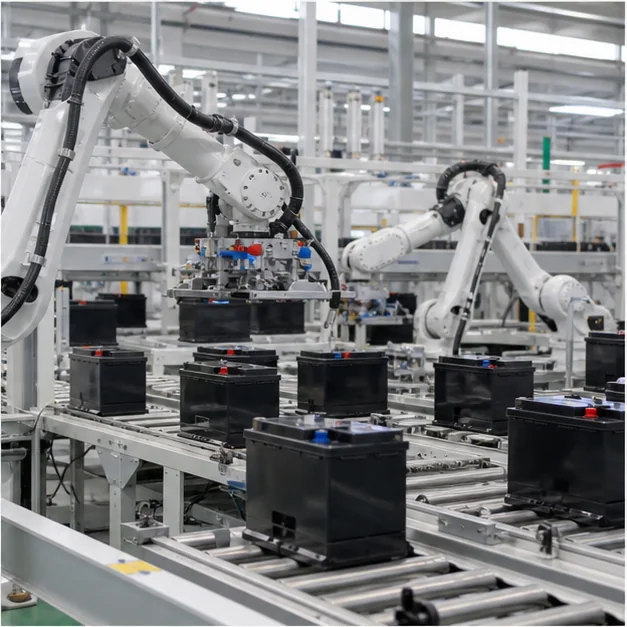
Buyers should audit the Chinese factory's manufacturing route from lead-alloy control and plate casting through curing, assembly, formation, capacity testing and final inspection. Plate casting parameters, grid alloy records and lot traceability should be included in the supplier quality plan. For export logistics, confirm the battery design and current carrier requirements before assigning UN2800 for qualifying non-spillable batteries or UN2794 for wet batteries; sea freight documentation, packaging and test evidence must match the actual product.
A competent China battery manufacturer can produce a private label battery that meets your target performance envelope—CCA, reserve capacity, and cycle life—provided you supply a clear specification. What they cannot do is guarantee compliance with every international standard without you specifying the target market. The factory builds to your spec, not to a vague notion of "quality."
Your first step is to separate marketing claims from verifiable process data. Ask for the following in your initial RFQ:
- Plate chemistry and grid alloy: Confirm whether the factory uses lead-calcium-tin or lead-antimony grids. For automotive SLI (starting, lighting, ignition) batteries, lead-calcium is standard for maintenance-free designs. For deep-cycle or dual-purpose, antimony content may be higher.
- Plate casting method: Book mold (gravity) vs. continuous casting. Continuous casting offers more consistent grid thickness and weight, which directly affects cold cranking amps (CCA) and vibration resistance.
- Pasting and curing parameters: Ask for the paste density (g/cm³) and curing chamber temperature/humidity ranges. A factory that cannot articulate these numbers is not a serious OEM partner.
- Formation process: Tank formation vs. container formation. Container formation is more efficient and reduces handling damage, but tank formation allows for tighter QC on individual plates.
Do not accept a factory's claim of "ISO 9001" as a proxy for battery quality. ISO 9001 is a process management standard, not a product performance standard. You need to verify the factory's internal QC checkpoints: plate weight sampling frequency, acid specific gravity (SG) tolerance, and final open-circuit voltage (OCV) testing.
MOQ, Tooling, and Box Design: The Real Cost Structure
MOQ: What You Are Actually Buying
MOQs for private label automotive batteries from China typically range from 200 to 1,000 units per SKU, depending on the factory's production line and your battery group size (e.g., Group 24, 34, 48, 49). A factory with automated assembly lines will prefer larger runs—often 500 units minimum—to justify line changeover time. Smaller MOQs (200–300 units) are possible but will incur a per-unit premium of 5–10% to cover setup costs.
Key negotiation points:
- Mixed container loads: Ask if the MOQ applies per SKU or per container. Some factories allow a 20-foot container (approx. 400–600 units of Group 24–35) with mixed group sizes, as long as the total volume is met.
- Phased orders: If you are a new importer, propose a pilot order of 100–200 units for field testing, then scale to full MOQ after 90 days. Many Chinese OEM factories accept this if you commit to a second order in writing.
- Seasonal flexibility: Battery demand peaks in winter (for cold-cranking markets) and pre-monsoon (for tropical markets). Negotiate a framework agreement that allows you to adjust monthly volumes within ±20% of a baseline.
Tooling: What You Pay For and What You Own
Tooling for private label batteries falls into three categories:
- Box/Container mold: The plastic battery case (polypropylene or ABS) is the most expensive tool. A custom box design with your brand embossed on the lid and sidewalls costs $8,000–$15,000 for a single cavity mold. Multi-cavity molds (2 or 4 cavities) increase throughput but cost 1.5–2x more.
- Handle and lid tooling: If you want a specific handle design (e.g., rope handle vs. rigid strap), expect $2,000–$5,000 per design.
- Label and artwork plates: These are low-cost (under $500) and often waived if you order a minimum quantity of labels.
Critical ownership clause: Your contract must state that the tooling is your property, even if the factory pays for it upfront and amortizes the cost into your unit price. If you switch suppliers later, you want the right to retrieve the molds or have them transferred to a new factory. Without this clause, you are paying for tooling you do not control.
Box Design: Engineering, Not Just Aesthetics
Your box design affects more than brand recognition. It impacts:
- Vibration resistance: The internal ribbing and plate support structure must match the battery's group size and weight. A poorly designed box can lead to plate shorting under vibration, a common cause of premature failure in automotive applications.
- Thermal management: Polypropylene (PP) is the standard material for automotive batteries because of its balance of impact resistance and thermal stability. ABS is stiffer but more brittle at low temperatures. Specify the material grade and wall thickness (typically 2.5–3.5 mm) in your RFQ.
- Terminal configuration: Your box design must accommodate the terminal type (top post, side post, or dual) and the exact torque specs for cable connections. A mismatch here is a field failure waiting to happen.
Verification step: Request a 3D drawing (STEP or IGES file) of the proposed box design and have your own engineer review the internal plate support ribs. Do not rely on the factory's rendering alone.
Chinese Factory Manufacturing Processes and Export Logistics
Plate Casting and Lead-Alloy Controls
A reputable Chinese OEM factory will use either a Wirtz or MAC plate casting machine for automotive grids. These machines produce grids with a tolerance of ±0.05 mm in thickness and ±1% in weight. The lead alloy is typically lead-calcium-tin (0.08–0.12% calcium, 0.3–0.6% tin) for maintenance-free batteries. The factory should provide a spectrometer analysis certificate for each batch of alloy, showing the trace element content (e.g., bismuth, silver, zinc) that affects grid corrosion and water loss.
Ask for the factory's paste mixing log. The paste should be mixed at a controlled temperature (below 60°C) to prevent premature curing. The specific gravity of the paste is typically 4.0–4.2 g/cm³ for automotive plates. If the factory cannot provide this data, treat it as a red flag.
Production QC: What to Audit On-Site
If you visit the factory (and you should), focus on these checkpoints:
- Incoming lead inspection: Is the lead (99.99% purity) tested for impurities before melting?
- Grid casting: Are grids weighed and visually inspected at a rate of at least 1 per hour per line?
- Pasting and curing: Is the curing chamber temperature and humidity logged automatically? Is there a visual inspection for paste cracks?
- Formation and filling: Is the acid filling done under vacuum? Is the specific gravity of the acid verified after filling (typically 1.28–1.30 SG for automotive)?
- Final testing: Does the factory perform a 100% OCV and CCA test on every battery? Or only a sample? For private label, you should insist on 100% testing of CCA and OCV, with a documented test report for each unit.
Export Logistics: UN2800 vs. UN2794 and Sea Freight Documentation
This is where many importers make costly errors. The UN number for your battery shipment depends on the battery's construction and electrolyte state:
- UN2800 applies to batteries, wet, non-spillable—this covers sealed (VRLA) batteries that pass the vibration and pressure differential tests in the UN Manual of Tests and Criteria. These batteries are not subject to the full dangerous goods regulations if they meet specific conditions (e.g., no free liquid, terminals protected).
- UN2794 applies to batteries, wet, filled with acid—this covers conventional flooded lead-acid batteries that contain free liquid electrolyte. These are fully regulated as Class 8 corrosive materials.
Do not assume your battery is UN2800 just because it is "maintenance-free." A sealed battery with a one-way valve is not automatically non-spillable. The factory must provide test evidence that the battery passes the vibration (3 hours at 1.2 mm amplitude) and pressure differential (95 kPa) tests.
For sea freight, the documentation differs:
- UN2800 (non-spillable): If the battery meets the conditions of Special Provision 238, it is not subject to the dangerous goods regulations, but you still need a Material Safety Data Sheet (MSDS) and a non-spillable battery test report. The bill of lading can show "Not Regulated as Dangerous Goods" if the conditions are met.
- UN2794 (wet, filled with acid): This requires a Dangerous Goods Declaration, a UN certification mark on the battery, and the shipment must be stowed and segregated per IMDG Code rules. The carrier will charge a dangerous goods surcharge.
Verification step: Before booking freight, send your battery specification and test reports to your freight forwarder or a third-party testing lab (e.g., SGS, TÜV) to confirm the correct UN classification. Do not rely on the factory's label alone.
Sourcing from China: RFQ Data and Verification Steps
When you send an RFQ to a China automotive battery manufacturer, include the following data to get a meaningful quote:
- Battery group size (BCI or DIN/EN standard)
- CCA rating (at -18°C) and the test standard (SAE, EN, or IEC)
- Reserve capacity (minutes at 25A discharge)
- Terminal type and torque spec
- Box dimensions and weight limit
- Target market climate (affects acid SG and plate thickness)
- Private label requirements (logo, label, box color)
- Annual volume forecast (helps factory plan capacity)
Ask for a sample batch (5–10 units) before committing to a full order. Test these samples in your own lab or with a third party for CCA, capacity, and vibration resistance. A factory that refuses to provide samples or charges an exorbitant sample fee is not a serious partner.
For a broader view of Chinese supplier capabilities, you can also review Chinese battery suppliers for motorcycle applications or solar storage battery sourcing from China to see how the same factory may serve different verticals.
Comparison: Flooded vs. AGM vs. EFB for Private Label
| Parameter | Flooded (UN2794) | AGM (UN2800) | EFB (UN2800) |
|---|---|---|---|
| CCA (typical) | 500–800 A | 600–900 A | 550–850 A |
| Cycle life (80% DoD) | 200–300 cycles | 300–500 cycles | 300–400 cycles |
| Water loss | High (requires maintenance) | Low (sealed) | Low (sealed) |
| Vibration resistance | Moderate | High | High |
| Cost per unit (example) | $45–$65 | $70–$100 | $60–$85 |
| UN classification | UN2794 (wet, filled with acid) | UN2800 (non-spillable) | UN2800 (non-spillable) |
| Typical application | Standard passenger cars | Start-stop, luxury vehicles | Start-stop, mid-range vehicles |
Note: CCA and cycle life ranges are indicative examples based on common Group 24–48 sizes. Confirm the exact values with your factory's test data and the relevant standard (SAE J537, EN 50342, or IEC 60095) for your target market.