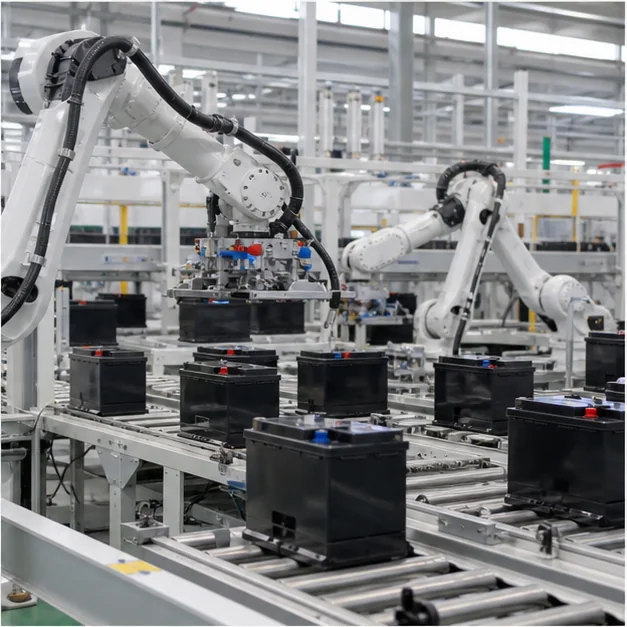
Answer: For tropical markets, sealed maintenance free (SMF) batteries from a China battery manufacturer generally offer lower total cost of ownership due to reduced water loss, better vibration resistance, and safer logistics (UN2800). Dry charged units remain viable for low-usage fleets with strict storage needs, but require disciplined activation and carry higher spillage risk (UN2794). Your sourcing decision should weigh ambient temperature, recharge discipline, and freight classification. Confirm current carrier rules before finalizing specifications.
Understanding the Core Chemistry and Design Differences
The fundamental distinction between SMF and dry charged batteries lies in electrolyte state and plate chemistry. SMF batteries ship with electrolyte absorbed in a glass mat (AGM) or gelled, sealed against spillage. Dry charged batteries ship without electrolyte; the plates are formed, washed, dried, and sealed, with electrolyte added at point of use.
For tropical importers, this difference drives every downstream decision—from warehouse planning to fleet maintenance schedules.
Plate Alloy Composition and Heat Tolerance
SMF batteries typically use lead-calcium or lead-calcium-tin alloys for the positive grid. Calcium reduces gassing (water electrolysis) significantly compared to traditional antimony alloys. In tropical conditions where under-hood temperatures routinely exceed 40°C, this translates to measurable water retention.
Dry charged batteries often retain antimony or low-antimony alloys. Antimony strengthens the grid and improves deep-cycle recovery, but it catalyzes gassing. A dry charged battery in a hot climate will lose water faster once activated, requiring periodic electrolyte level checks—a task often neglected in fleet operations.
| Parameter | SMF (AGM/Gel) | Dry Charged (Conventional) |
|---|---|---|
| Electrolyte state at shipment | Absorbed in mat or gelled | None (added at activation) |
| Typical plate alloy | Lead-calcium-tin | Lead-antimony or low-antimony |
| Water loss rate at 40°C | Low (sealed, recombination) | Moderate to high (gassing) |
| Storage life unactivated | 6-12 months (self-discharge) | 18-24 months (dry, sealed) |
| Activation required | No | Yes (fill + initial charge) |
| Tilt/spill risk | Non-spillable (UN2800) | Spillable if filled (UN2794) |
| Typical cycle life (tropical, 50% DoD) | 400-600 cycles (example) | 250-400 cycles (example) |
| Maintenance requirement | None | Periodic water top-up |
Values are illustrative ranges based on typical commercial products. Confirm actual specifications with your supplier.
Recombination Efficiency and Thermal Runaway
SMF batteries operate on the oxygen recombination principle. Oxygen generated at the positive plate diffuses to the negative plate and recombines, minimizing water loss. This works well within a temperature window of 20-45°C. Above 50°C, recombination efficiency drops, and internal pressure rises. Quality SMF batteries include pressure relief valves, but sustained high temperatures accelerate grid corrosion.
Dry charged batteries have no such recombination mechanism. Once filled, they behave as conventional flooded batteries. In tropical heat, the electrolyte temperature rises, accelerating both gassing and grid corrosion. This is manageable if the battery is oversized and the charging voltage is temperature-compensated—but that requires disciplined system design.
Tropical Climate Performance: Heat, Humidity, and Duty Cycles
Tropical markets present three simultaneous stressors: high ambient temperature, high humidity, and often erratic grid power leading to frequent deep discharges.
Temperature Effects on Capacity and Life
Lead-acid chemistry is temperature-sensitive. Capacity increases slightly with heat, but life decreases sharply. The Arrhenius equation governs this: for every 8-10°C above 25°C, battery life halves. A battery rated for 500 cycles at 25°C may deliver only 250 cycles at 35°C.
SMF batteries with calcium alloys tolerate this better because grid corrosion is more uniform. Dry charged batteries with antimony alloys suffer accelerated positive grid growth, leading to premature capacity loss.
Humidity and Corrosion
High humidity attacks terminal connections and external metal parts. SMF batteries typically have sealed terminals with corrosion-resistant coatings. Dry charged batteries, especially those with exposed terminal posts, require periodic cleaning and application of anti-corrosion grease.
Deep Discharge Recovery
Fleet vehicles in tropical regions often experience deep discharges due to auxiliary loads (lights, refrigeration, communication equipment) when the engine is off. SMF AGM batteries handle deep discharges better than conventional flooded designs due to their lower internal resistance and higher acid density. Dry charged batteries, once activated, are more forgiving of repeated deep discharges if the antimony content is adequate—but they require diligent recharging.
Procurement consideration: If your application involves frequent deep cycling, specify a dual-purpose SMF battery with thicker plates. If your application is primarily starting with occasional deep discharge, a quality dry charged battery may suffice at lower initial cost.
Sourcing from China: Factory Processes, QC, and Export Logistics
Buyers should audit the Chinese factory's manufacturing route from lead-alloy control and plate casting through curing, assembly, formation, capacity testing and final inspection. Plate casting parameters, grid alloy records and lot traceability should be included in the supplier quality plan. For export logistics, confirm the battery design and current carrier requirements before assigning UN2800 for qualifying non-spillable batteries or UN2794 for wet batteries; sea freight documentation, packaging and test evidence must match the actual product.
When sourcing from a China automotive battery manufacturer, you are buying more than a product—you are buying a manufacturing process. Understanding how Chinese factories produce these batteries helps you ask the right questions and avoid costly specification mismatches.
Plate Casting and Alloy Control
Chinese OEM factories typically use either book-mold casting or continuous grid casting (e.g., Wirtz or Sovema lines). Book-mold casting is common for smaller runs and allows alloy changes between batches. Continuous casting offers tighter grid weight tolerance (±1-2%) and better metallurgical consistency.
What to verify: Ask your supplier for their grid weight tolerance and alloy composition certificate. A reputable factory will provide a spectrographic analysis showing calcium, tin, and aluminum content (for calcium alloys) or antimony content (for antimony alloys). Confirm the alloy matches your climate requirements—do not accept a generic "low antimony" claim without numbers.
Paste Mixing and Curing
The active material (lead oxide paste) must be mixed to a specific density (typically 3.8-4.2 g/cm³) and cured under controlled temperature and humidity. Poor curing leads to plate cracking and premature shedding.
Factory audit question: "What is your curing chamber temperature and humidity profile?" A serious factory will have documented profiles (e.g., 50-70°C, 95-100% RH for 24-48 hours). Avoid suppliers who cannot articulate this.
Formation and Quality Control
Formation is the electrochemical process that converts raw plates into charged plates. This is energy-intensive and time-consuming (24-72 hours). Some factories skip full formation to save cost, shipping batteries that are only 60-70% formed. These batteries will never reach rated capacity.
QC verification: Request formation records for a sample batch. Look for consistent final voltage and specific gravity readings. A reliable China battery supplier will provide batch-level test data including capacity test results (C20 rating) and charge acceptance.
Export Logistics: UN2800 vs UN2794 and Sea Freight Documentation
This is where many importers make costly errors. The UN classification determines your shipping options, labeling, and documentation.
UN2800 applies to "batteries, wet, non-spillable." SMF batteries that pass the vibration and pressure differential tests in Special Provision 238 can ship as non-spillable. This classification allows them to be transported without the full hazardous goods declaration in many cases, though you must still confirm with your carrier. For sea freight, UN2800 batteries are often shipped as general cargo, significantly reducing freight cost and lead time.
UN2794 applies to "batteries, wet, filled with acid, spillable." This applies to conventional flooded batteries, including dry charged units that have been filled and activated. These require full hazardous goods documentation, Class 8 corrosive labeling, and stowage segregation. Sea freight costs are higher, and some carriers restrict them to specific container types.
Critical distinction: Dry charged batteries shipped without electrolyte are not classified under either UN number—they are typically shipped as non-dangerous goods if the plates are dry and the battery is sealed. However, once electrolyte is added at destination, the battery becomes UN2794 for any onward transport. This creates a compliance burden for distributors who activate batteries locally.
Documentation checklist for sea freight:
- Material Safety Data Sheet (MSDS) for the battery and electrolyte
- Dangerous Goods Declaration (if UN2794)
- Certificate of conformity for UN2800 (if claiming non-spillable)
- Marine pollutant assessment (lead compounds are marine pollutants)
- Container packing certificate (CTU code)
RFQ data you must provide to your supplier:
- Target UN classification (specify UN2800 or UN2794)
- Intended storage duration before activation
- Average ambient temperature at deployment site
- Typical duty cycle (starting vs deep cycle)
- Required CCA (cold cranking amps) at 0°F and at 32°F
- Reserve capacity (RC) in minutes
- Physical dimensions and terminal type (SAE, JIS, DIN)
Cost-Benefit Analysis for Importers and Fleet Operators
The initial purchase price of dry charged batteries is typically 10-20% lower than equivalent SMF units. However, total cost of ownership (TCO) tells a different story in tropical conditions.
Direct Cost Comparison
| Cost Factor | SMF Battery | Dry Charged Battery |
|---|---|---|
| Initial purchase price | Higher (reference: $45-70 for 60Ah) | Lower (reference: $35-55 for 60Ah) |
| Freight cost (sea, per container) | Lower (UN2800, general cargo) | Higher (UN2794, hazmat) |
| Storage cost | Limited shelf life (6-12 months) | Longer shelf life (18-24 months) |
| Activation labor | None | $2-5 per unit (labor + electrolyte) |
| Maintenance cost (3-year period) | Near zero | $5-15 per unit (water top-ups) |
| Replacement frequency (tropical) | 2-3 years (example) | 1.5-2.5 years (example) |
Costs are indicative examples for a 60Ah automotive battery in a Southeast Asian market. Obtain current quotes from your Chinese supplier.
Hidden Costs of Dry Charged Batteries
Activation requires electrolyte (sulfuric acid at 1.260-1.280 specific gravity) and a controlled initial charge. If the initial charge is skipped or rushed, the battery will never reach full capacity. This is a common failure mode in tropical markets where distributors prioritize speed over proper activation.
Additionally, dry charged batteries require separate acid inventory, which is a hazardous material in itself. This adds warehouse compliance costs and safety training requirements.
When Dry Charged Makes Sense
Dry charged batteries remain viable for:
- Low-usage vehicles (agricultural equipment, seasonal fleets)
- Markets with unreliable cold-chain logistics (where SMF self-discharge during storage is a concern)
- Applications where battery weight is critical (dry batteries are lighter before activation)
- Buyers with established acid handling infrastructure
Quality Verification and Supplier Auditing
Before committing to a China automotive battery manufacturer, implement a structured verification process.
Factory Audit Checklist
- Plate casting: Inspect grid weight consistency. Weigh 20 grids from a production run; deviation should be under 3%.
- Paste mixing: Check paste density logs and curing chamber records.
- Formation: Verify formation time (minimum 24 hours) and final voltage readings.
- Assembly: Check for proper seal integrity (no electrolyte leakage in tilt test).
- Testing: Request C20 capacity test results and CCA test data for sample batches.
Third-Party Testing
For critical orders, commission third-party testing at a recognized laboratory (e.g., SGS, TÜV, Bureau Veritas). Tests should include:
- Capacity test (C20) at 25°C
- CCA test at -18°C
- Charge retention test (28 days)
- Vibration resistance test (for UN2800 classification)
Documentation Verification
Request and verify:
- ISO 9001 certificate (quality management)
- ISO 14001 certificate (environmental management)
- UN38.3 test report (if applicable for transport)
- MSDS in English and destination country language
- Certificate of origin (for tariff purposes)