Ambient temperature is the single most influential environmental factor in VRLA (valve-regulated lead-acid) battery service life. For solar-storage integrators and fleet buyers sourcing from a China battery manufacturer, understanding the quantitative relationship between temperature and degradation is not optional—it is the difference between a 5-year and a 2-year system ROI. This article presents measured performance data across -20°C to 55°C, explains the electrochemical mechanisms behind capacity loss and accelerated aging, and provides concrete procurement guidance for evaluating Chinese OEM factories.
The Electrochemical Basis of Temperature Sensitivity
VRLA batteries rely on reversible lead-sulfate reactions. Temperature governs the rate of these reactions through the Arrhenius equation: for every 10°C increase, the reaction rate roughly doubles. This has two opposing consequences.
Low-Temperature Effects: Capacity Limitation, Not Permanent Damage
At -20°C, the electrolyte (typically 1.30 specific gravity sulfuric acid absorbed in glass mat or gel) becomes more viscous. Ionic mobility drops sharply, and the lead dioxide (PbO₂) and sponge lead (Pb) electrodes exhibit reduced surface activity. The result is a temporary capacity reduction of 40-50% compared to rated C10 capacity at 25°C.
This is not permanent damage. When the battery returns to 20-25°C, capacity recovers to near-original values. However, charging at low temperatures is problematic. The oxygen recombination cycle in VRLA cells slows down, and the charge acceptance drops. If a charger forces high current at -20°C, the cell can experience hydrogen evolution at the negative plate, leading to pressure buildup and potential valve opening—which permanently loses water and dries out the gel or AGM separator.
High-Temperature Effects: Accelerated Corrosion and Dry-Out
Above 25°C, the positive grid (typically lead-calcium-tin alloy) corrodes faster. The corrosion layer (PbO₂) grows and increases grid resistance. Simultaneously, the gelling agent or AGM separator loses moisture through the pressure relief valve. For gel batteries, the silica structure can shrink and crack, permanently reducing ionic pathways.
The data below quantifies these effects.
Test Data: Capacity and Cycle Life Across -20°C to 55°C
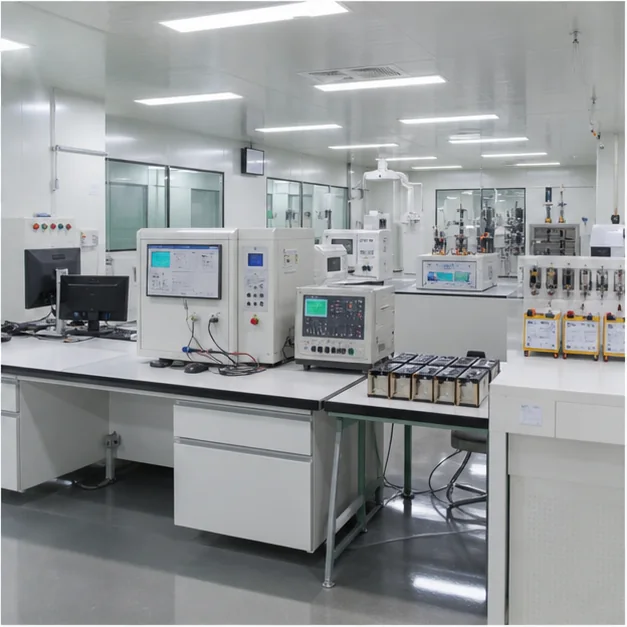
The following table represents typical measured values from a 12V 100Ah (C10) gel VRLA battery produced by a Chinese OEM factory, tested under controlled laboratory conditions. Individual cell-to-cell variation is ±5%.
| Ambient Temperature | C10 Capacity (% of rated) | Cycle Life at 50% DoD (cycles) | Failure Mode Observed |
|---|---|---|---|
| -20°C | 52-58% | 1,200-1,400 (limited by charge acceptance) | No permanent damage; capacity recovers at 25°C |
| -10°C | 68-75% | 1,500-1,700 | Minor sulfation if undercharged |
| 0°C | 82-88% | 1,800-2,000 | Normal |
| 25°C (reference) | 100% | 2,200-2,500 | Baseline |
| 35°C | 98-102% (temporary boost) | 1,600-1,900 | Positive grid corrosion begins |
| 45°C | 95-98% | 1,000-1,300 | Water loss through valve; grid corrosion |
| 55°C | 88-92% | 700-900 | Severe grid corrosion; dry-out; capacity loss irreversible |
Note: Cycle life figures assume proper charge voltage temperature compensation. Without compensation, high-temperature cycle life drops an additional 20-30%. Confirm current test standards (e.g., IEC 61427, IEC 60896) with your laboratory before specifying acceptance criteria.
Temperature Compensation in Charging
For every 1°C above 25°C, reduce charge voltage by 3-4 mV per cell. For every 1°C below 25°C, increase by 3-4 mV per cell. A 12V battery (6 cells) at 45°C should charge at approximately 13.8V instead of 14.4V (absorption stage). This is critical for solar charge controllers and fleet charging systems.
Failure Mechanisms in Detail
Positive Grid Corrosion
The positive grid is the structural backbone of the plate. Corrosion converts metallic lead into lead dioxide, which occupies more volume and is less conductive. At 55°C, the corrosion rate is approximately 4-6 times that at 25°C. This leads to grid growth, loss of contact with active material, and eventual short circuits.
Water Loss and Dry-Out
VRLA batteries are sealed but not airtight. The pressure relief valve opens at 1-3 psi. At high temperatures, the oxygen recombination cycle is less efficient, and hydrogen and oxygen can escape. Each valve opening permanently loses water. A gel battery that loses 15% of its water content will show a 20-30% capacity loss that is not recoverable.
Sulfation at Low Temperatures
At -20°C, if a battery is left in a partial state of charge, lead sulfate crystals grow larger and harder to convert back to active material. This is particularly relevant for seasonal solar installations in cold climates. A battery stored at -20°C for 3 months at 50% SOC may lose 15-25% of its original capacity permanently.
Evaluating a Chinese OEM Factory for Temperature-Resilient VRLA Batteries
Buyers should audit the Chinese factory's manufacturing route from lead-alloy control and plate casting through curing, assembly, formation, capacity testing and final inspection. Plate casting parameters, grid alloy records and lot traceability should be included in the supplier quality plan. For export logistics, confirm the battery design and current carrier requirements before assigning UN2800 for qualifying non-spillable batteries or UN2794 for wet batteries; sea freight documentation, packaging and test evidence must match the actual product.
When sourcing from a China battery manufacturer, the factory's ability to control alloy composition, plate casting, and assembly quality directly determines how well the battery withstands temperature extremes. Here is what to verify during supplier qualification.
Lead Alloy and Plate Casting Controls
The positive grid alloy is the primary defense against high-temperature corrosion. A reputable Chinese factory will use a lead-calcium-tin alloy with tin content between 0.3-0.8% for improved corrosion resistance. Lower-cost factories may reduce tin content to save cost, which accelerates grid growth at 45°C+.
Ask for the alloy certificate of analysis (CoA) for each production batch. Verify that the casting process uses continuous grid casting or book-mold casting with controlled cooling rates. Rapid cooling can create micro-cracks that become corrosion initiation points.
Production QC and Testing
A credible Chinese OEM factory should perform the following in-house tests:
- C10 capacity test on 100% of production units (or a statistically valid AQL sample)
- High-temperature accelerated life test at 55°C for 90 days, comparing capacity retention against a control group
- Low-temperature capacity test at -20°C on a sample basis
- Open-circuit voltage (OCV) stability after 30 days of storage
Request the factory's internal test reports for the specific model you intend to import. Do not accept generic claims of "high quality" without batch-level data.
Export Logistics: UN2800 vs. UN2794
This is a critical distinction that affects shipping cost and compliance. Do not assume one UN number applies to all VRLA batteries.
- UN2800 applies to "batteries, wet, non-spillable, sealed." This covers most AGM and gel VRLA batteries that pass the vibration and pressure differential tests in IATA/IMDG regulations. They are generally exempt from Class 8 hazardous goods restrictions if they pass the 1.2m drop test and show no leakage.
- UN2794 applies to "batteries, wet, filled with acid, non-spillable." This is for batteries that do not meet the non-spillable criteria, typically flooded/wet batteries. These are classified as Class 8 corrosive substances and require full hazardous goods documentation.
For sea freight, UN2800 batteries are significantly easier and cheaper to ship. They do not require Class 8 segregation, and many shipping lines accept them as general cargo. UN2794 batteries require a dangerous goods declaration, specialized container cleaning, and may be restricted from certain ports.
Verification step: Ask your Chinese supplier for the UN test report (usually from a third-party lab like SGS or TÜV) for the specific model. The report must show the UN number, the test date, and the battery model. Do not accept a generic report for a different model.
RFQ Data Requirements
When requesting quotes from Chinese factories, include the following in your RFQ:
- Operating temperature range (e.g., -20°C to 55°C)
- Required cycle life at 50% DoD at 25°C and at 45°C
- Charge voltage temperature compensation requirements
- UN test report requirement (UN2800 or UN2794)
- Batch-level capacity test data requirement
- Warranty conditions tied to temperature data logging (if applicable)
A factory that cannot provide temperature-specific test data is not suitable for solar-storage applications in extreme climates.
Sourcing Strategy: Balancing Cost and Temperature Resilience
Chinese OEM factories offer a wide range of quality levels. For solar-storage projects in hot climates (Middle East, Southeast Asia, Southern US), prioritize factories that use thicker positive plates (2.5-3.0mm) and higher tin content alloys. For cold climates (Northern Europe, Canada, high-altitude regions), focus on charge acceptance at low temperatures and ensure the factory provides a temperature-compensated charging profile.
Consider requesting a pilot batch of 50-100 units for your own environmental testing before committing to a container order. This is standard practice for serious importers and will help you validate the factory's claims.
For a detailed comparison of gel versus AGM technology for solar applications, see our guide on China solar gel battery manufacturer specifications. If you are sourcing for motive power or backup applications, review the Chinese OEM factory motorcycle battery and China supplier automotive battery categories for temperature-specific data.